






Live investigations of false fire alarms
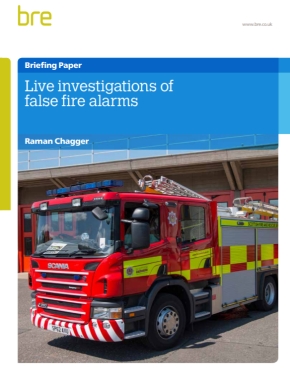
Live investigations of false fire alarms was written by Raman Chagger and published by BRE in December 2015. Recommendations made as a result of this project can help to significantly reduce the occurrence of false fire alarms.
Fire detection and fire alarm systems (FDFAS) are used to provide early warning of fire in order to alert the local Fire and Rescue Service (FRS). FRS attendance at fires saves lives, prevents injury and reduces associated property damage costs.
However, false alarms attribute to estimated losses of around £1 billion a year, resulting in disruption and loss of productivity for businesses. False alarms have the potential to divert fire and rescue services away from real fires, and also reduce the confidence of the general public in fire alarms. Despite this there is no single organisation responsible for investigating false alarms or providing guidance on reducing them.
This research aimed to identify the fundamental causes of false fire alarms, utilising a fire alarm industry expert to investigate false alarms as they occurred in the field in the greater Glasgow area. A comprehensive online questionnaire containing 124 questions was developed to enable the fire alarm investigator to record all details of the false alarms attended. This form of live investigation of false alarms had not previously been attempted. The fire alarm investigator assisted Scottish Fire and Rescue Service crews as they attended live callouts and, following a comprehensive investigation, completed online reports for each false alarm.
Data from his accounts and from 65 false alarm reports, gathered from November 2014 to April 2015, were analysed and 35 recommendations were made. These can significantly reduce false alarm occurrences and contribute to the greater integrity and reliability of fire detection systems.
The recommendations were made across nine different stakeholder groups, ensuring that fire and rescue services, fire risk assessors, business owners, fire alarm contractors, trade associations and others can all play their part in collectively reducing false alarms in the UK.
The contents of the briefing paper are:
- Summary.
- Abbreviations and glossary of terms.
- Introduction.
- Methodology.
- Summary of data gathered.
- Findings and recommendations.
- Future work.
- Conclusions.
- References.
The free briefing paper can be downloaded at: https://files.bregroup.com/research/Live-Investigations-of-False-Alarms_2015-December.pdf
[edit] Related articles on Designing Buildings Wiki
- BRE articles on Designing Buildings Wiki.
- Carbon monoxide detector.
- Fire detection and alarm system.
- Fire protection engineering.
- Fire.
- Heat alarm.
- Ionisation smoke alarm.
- Multi-sensor alarm.
- New requirements for fire detection and alarm network systems IP 12 13.
- Optical smoke alarm.
- Over £1 billion lost every year due to false alarms.
- Project SHOUT.
- Smoke alarm.
- The causes of false fire alarms in buildings.
Featured articles
Check out some of the best features and news from Designing Buildings as well as key stories from around the web.

CIAT confirm the winners of the 2026 architectural technology awards.

Government launches a one stop shop for flood preparedness.

Sir Edwin Lutyens: Britain's greatest architect? Book review.

CIOB publishes free template to help assess and manage risks.
ECA's reflections on Party Conference season

Burnham wants to be confident of winning before asking for a fresh mandate.
New Chief Construction and Scientific Adviser

Sergio Cavalaro, Professor of Infrastructure Systems at Loughborough University.
Building safety levy for England

CIAT publish estimator tool for members.

Water sector faces a growing crisis that could slow the delivery of vital infrastructure.
Undervaluing our industrial past

Heritage value changes as taste for building styles changes.
Changing expectations around competence and compliance

New information sheet from CIAT.
Grenfell investigation files passed to CPS

Angela Rayner apologises on behalf of the British state.

Electrical contractors need to understand the practical implications.